I’ve been using DeWalt power tools for nearly 20 years, and I keep coming back to them because of the trust I’ve built in the brand and the consistent quality of their tools. However, Milwaukee is a solid brand that’s taking a primary position in many of my colleagues’ toolboxes. So, whether you’re a seasoned builder or just starting out with your first power tool, I’m here to talk through which power tool brand is the best.
Key Takeaways From This Article
- Milwaukee and Dewalt produce a very similar range of tools
- Milwaukee tends to hold the edge in terms of power, speed and torque
- Dewalt holds the edge in terms of reliability
- Dewalt price points are generally more attractive
- Milwaukee offer a longer standard warranty
Read on to find out whether professionals prefer Dewalt or Milwaukee.
In a hurry? Read the final verdict here.

Milwaukee has been in the power tool industry since the early 1920s, with a solid reputation for designing innovative tools that meet the needs of professionals and serious DIYers.

DeWalt, founded in 1923, is known for its cutting-edge tools tailored to both DIY enthusiasts and professionals. However, DeWalt is generally more recognised in the UK, as it has been trading here for many years before Milwaukee entered the market. Visit the Dewalt history timeline here.
DeWalt, as a company, does have a slightly higher turnover than Milwaukee, which suggests it sells more products, but this doesn’t necessarily suggest that it has better products.
The ultimate question still remains. Is Milwaukee better than Dewalt?
Is Milwaukee Better Than DeWalt? Let’s take a Deeper Look
Here are the key factors that most professionals would consider when comparing power tools. I’ve rounded up all the points I’ve discussed with friends, colleagues and other like-minded users of these two brands. To give each of these brands a fair overall comparison I’ll be looking at:
- Price
- Performance
- Selection and variety of tools
- Durability and Build Quality
- Battery life and compatability
- Ergonomics and feel
- Warranty
1. Price
DeWalt tends to have the edge when it comes to pricing. This is particularly evident in Milwaukee’s M18 Fuel tools, which often come at a steeper price than DeWalt’s 18V Max XR series. In the example below, a standard Milwaukee impact driver is priced noticeably higher than the equivalent DeWalt model. If you’re on a budget or looking for good value, DeWalt is the more affordable option.
Dewalt DCF887 18V + 5Ah battery

- Max. Torque: 205Nm
- Impact rate: 3800ipm
- No load speed: 3250rpm
- 5.0Ah battery included
Milwaukee M18FID2-0 18v + 5Ah battery

- Max. Torque: 226Nm
- Impact rate: 4400ipm
- No load speed: 3900rpm
- 5.0Ah battery included
However, some tools from both brands are priced similarly. If you’re considering more specialised tools, such as DeWalt’s FlexVolt series, they can be more expensive than Milwaukee’s comparable products, depending on the specific tool. But in general, DeWalt has the upper hand when it comes to price.
2. Performance
When comparing power and torque between Milwaukee and DeWalt tools, particularly their drills and impact drivers, the results can vary depending on the specific tool models. However, here are some general insights:
Power (Voltage)
- DeWalt offers its tools primarily in the 18V Max and 60V FlexVolt systems. The 18V Max is equivalent to 18V in practice, while the FlexVolt tools can switch between 18V and 60V, offering more versatility and power for larger tools like miter saws and grinders.
- Milwaukee focuses on its M18 (18V) system, known for delivering high power, and its M12 (12V) system for more compact, lightweight tools. Milwaukee has also introduced the MX Fuel line, which provides power comparable to corded or gas-powered tools for larger industrial applications.
Examples and Comparisons
Let’s take a look at like-for-like specs on some of DeWalt and Milwaukee’s most popular tools.
Combi Drill – Key Specification Comparison
| Specification | Milwaukee M18 BPDN-402C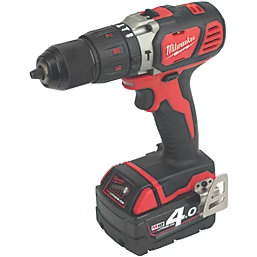 | DEWALT DCD778M2T-SFGB |
|---|---|---|
| Price (Screwfix 2026) | £199 | £199 |
| Brushless | No (Brushed) | Yes (Brushless) |
| Charge Time | 80 min | 100 min |
| Chuck Capacity | 13 mm | 13 mm |
| Handle Type | Rubber Overmould Grip | Soft-Grip Handle |
| Impact Rate | 28,800 bpm | 29,750 bpm |
| Low Battery Indicator | Yes | Yes |
| Manufacturer Guarantee | 3 Years (registration required) | 3 Years (registration required) |
| Max Torque | 60 Nm | 65 Nm |
| No Load Speed | 0–1800 rpm | 1750 rpm |
| No. Torque Settings | 16 | 15 |
| Voltage | 18 V | 18 V |
| Product Length | 198 mm | 240 mm |
| Tool Weight (with battery) | 2.1 kg | 1.85 kg |
At the same £199 price point, the DeWALT model offers a brushless motor, higher torque, slightly higher impact rate, and lighter weight, making it the more performance-focused and efficient option overall.
The Milwaukee model counters with a faster charge time, more torque settings, and shorter body length, which may appeal to users prioritising compactness and quicker turnaround between charges.
Impact Driver – Key Specification Comparison
| Specification | Milwaukee M18FID3-0 FUEL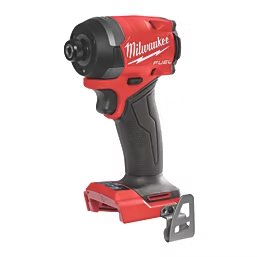 | DEWALT DCF840N-XJ |
|---|---|---|
| Price (Screwfix 2026) | £120 | £110 |
| Brushless | Yes | Yes |
| Chuck Capacity | 1/4″ | 1/4″ |
| Chuck Type | Hex / Square Drive | Hex Tool Holder |
| Handle Type | Rubber Overmould Grip | Soft-Grip Handle |
| Impact Rate | 4400 bpm | 4200 bpm |
| Manufacturer Guarantee | 3 Years (registration required) | 3 Years (registration required) |
| Max Torque | 226 Nm | 192 Nm |
| No Load Speed | 3900 rpm | 3200 rpm |
| Voltage | 18 V | 18 V |
| Product Length | 113 mm | 129 mm |
| Tool Weight (without battery) | 1.3 kg | 0.88 kg |
The Milwaukee delivers higher torque, faster impact rate, higher speed, and a more compact length, making it better suited for heavy-duty fastening.
The DeWALT is significantly lighter, which may be preferable for prolonged overhead or repetitive work where reduced fatigue is a priority.
Circular Saw – Key Specification Comparison
| Specification | Milwaukee HD18CS-0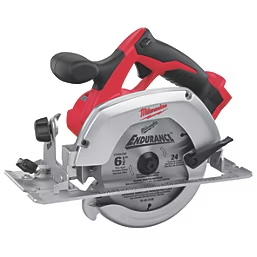 | DEWALT DCS391 |
|---|---|---|
| Price | £140 | £115 |
| Brushless | No (Brushed) | No (Brushed) |
| Blade Diameter | 165 mm | 165 mm |
| Bevel Angle Range | 0–90° | 0–50° |
| Cutting Depth Capacity | 55 mm | 55 mm |
| Max Cutting Depth @ 90° | 55 mm | 55 mm |
| Number of Teeth | 24 | 24 |
| No Load Speed | 3500 rpm | 5150 rpm |
| Manufacturer Guarantee | 3 Years (registration required) | 3 Years (registration required) |
| Voltage | 18 V | 18 V |
| Product Length | 314 mm | 360 mm |
| Tool Weight (without battery) | 3.1 kg | 3.2 kg |
The DeWALT offers a much higher no-load speed, favouring faster cutting performance.
The Milwaukee provides a wider bevel range and shorter body length, making it more versatile for angled cuts and slightly more compact.
Jigsaw – Key Specification Comparison
| Specification | Milwaukee M18 BJS-0 | DEWALT DCS331N |
|---|---|---|
| Price | £150 | £120 |
| Brushless | No (Brushed) | No (Brushed) |
| Bevel Angle Range | 0–45° | 0–45° |
| Blade Fitting Type | Universal Fitting | Bayonet Fitting |
| Max Cut in Steel | 10 mm | 10 mm |
| Max Cut in Wood | 135 mm | 135 mm |
| No Load Speed | 2800 spm | 0–3000 spm |
| Stroke Length | 25 mm | 26 mm |
| Tool Blade Change Facility | Quick-Release Blade Change | Tool-Free Blade Change |
| Switch Type | Trigger Switch | Lock-Off Switch |
| Manufacturer Guarantee | 3 Years (registration required) | 3 Years (registration required) |
| Voltage | 18 V | 18 V |
| Product Length | 230 mm | 305 mm |
| Tool Weight (without battery) | 2.6 kg | 2.4 kg |
The Milwaukee is more compact, while the DeWALT offers a slightly higher top speed, marginally longer stroke length, and lighter weight. Cutting capacities are identical, so the choice largely comes down to ergonomics and handling preferences.
Overall brand comparison in terms of performance
Based on the above comparisons, I believe DeWALT offers the more consistent all-around package thanks to wider use of brushless motors, higher average performance figures, and efficient XR technology, making it the better general-purpose choice.
Milwaukee does, however, stand out for raw power and compact design, particularly in high-torque tools like impact drivers, making it the stronger option for heavy-duty fastening and demanding applications.
3. Tool Selection

Milwaukee is highly regarded for its innovation and breadth of tools, especially in tradesmen-specific categories. Its M18 and M12 platforms are incredibly versatile, covering a wide range of tasks. For those who work in trades such as plumbing or electrical, Milwaukee’s broad selection of specialty tools is appealing.

DeWalt also offers a vast range of tools and has been a long-time leader in the market. The company’s 18V Max XR platform covers most homeowner and professional needs, from drills and drivers to saws and grinders. One advantage DeWalt has is their FlexVolt line, which offers tools that can run on both battery and AC power, making them extremely versatile for high-demand tasks.
4. Durability and Build Quality
Over the years, I’ve noted that most people in my circle believe that DeWalt tools are slightly more durable when it comes to withstanding abuse on the job. For example, I’ve heard stories of someone dropping a DeWalt mitre saw from an eight-foot height, and it came away unscathed. I’ve also heard mention that Milwaukee tools have experienced issues with motors and broken handles, though these may be outlier cases rather than widespread problems. Overall, both brands manufacture durable, high-quality tools, but in my mind, DeWalt have a slight edge in cases of wear and tear.
5. Battery Life and Compatibility
Battery life is crucial for any power tool user. Milwaukee’s M12 line is considered the leader in the 12V market, and their batteries are known for their longevity. DeWalt, on the other hand, neglected the 12V market for a while, giving Milwaukee the advantage here. However, DeWalt’s 18V Max and FlexVolt systems are robust and provide long-lasting power.
Dewalt 5.0Ah Battery

- 18v
- 0.62kg
- LED state of charge
Milwaukee 5.0Ah Battery

- 18v
- 0.77kg
- LED state of charge
Another thing to consider is the cross-compatibility of tools and batteries. Milwaukee’s M18 tools are not compatible with their M12 batteries, meaning you’ll need separate chargers and batteries for each line. DeWalt offers more flexibility here, as some of their accessories, such as radios and chargers, are compatible across their 12V and 18V Max platforms. This is something to keep in mind if you want a more streamlined battery system for all your tools.
6. Ergonomics and Feel
A recurring theme among my peers is that ergonomics matter just as much as performance. You’ll be handling these tools for extended periods, so comfort and ease of use are essential. I would suggest visiting a hardware store and physically picking up the tools to see which fits your hand better. Milwaukee tools tend to have a more rugged, industrial feel, while DeWalt is known for slightly more comfortable, ergonomic designs.
7. Warranty
When investing in power tools, warranty coverage is something to consider. Milwaukee offers a 5-year warranty on most of its tools, while DeWalt offers 3 years. Depending on how often and intensely you use your tools, a longer warranty could be a deciding factor.
Final Verdict: Which is Better?
When it comes to choosing between DeWALT and Milwaukee, you are comparing two of the most trusted names in power tools. The truth is, both brands deliver professional-grade performance. However, after decades of hands-on use, side-by-side spec comparisons, and feedback from other tradespeople, DeWALT emerges as the better all-around brand for most users, thanks to its stronger reliability record, broader use of brushless motors, more attractive pricing, and excellent long-term durability. Milwaukee, on the other hand, frequently wins in terms of raw power, torque, and compact design, making it a superb choice for heavy-duty fastening and specialised trade applications.
Quick buyer tips
- Choose DeWALT if you value reliability, long term ownership, value for money, and a balanced tool range.
- Choose Milwaukee if you prioritise maximum torque, compact tools, and cutting edge features.
- If you are starting from scratch, pick the brand whose battery platform best matches the tools you will add in future.
Final Verdict
For most DIYers and professionals alike, DeWALT is the better overall choice, while Milwaukee is the better high-performance specialist brand. You cannot go wrong with either, but if you want a safe long-term investment, DeWALT gets the nod.

Newbie Drill Buyers: Milwaukee or DeWalt?
If you’re specifically in the market for a drill, both brands have excellent options. Milwaukee’s M18 Fuel line is often touted as the best in terms of power and innovation, especially with features like One-Key for tracking and managing tools. However, DeWalt’s 18V Max XR drills are well-known for their reliability and slightly lower price point, making them great for those who want high performance without breaking the bank.
Let’s take a quick look at the impact drivers as an example of power and speed.
Without me going into a science lesson, you can find out what a Nm (Newton meter) is here. IPM stand for impacts per minute. It’s the number of times the hammer hits the anvil in one minute. You can read my other article about impact drivers here.
I have a biased opinion on this matter as I’ve primarily owned Dewalt tools for most of my professional career. Given the option to start from scratch with my tool collection, I’d likely stay with Dewalt. I love all the hidden features of the Dewalt drills and other tools. I still own some of my original tools from the brand, some 10 years on, so I have no reason to doubt or switch to another brand.
My Power Tool Experience and History
I started out my professional handyman career as an AV technician installing digital signage and audio systems for the conference and events industry. I used my trusty Dewalt combi drill on a daily basis and relied on it to deliver when I needed it. My first ever professional quality power tool was the Dewalt DC727, and I live by it. It was like an extension of my arm. It went to every show with me for four years and then onto my next role as a self employed handyman. It eventually got retired after nearly 10 years when the battery finally died. That’s pretty impressive!

At the time, I had to decide whether to replace the battery or invest in a new drill. Switching to another brand never even crossed my mind. I was so impressed with DeWalt’s quality and durability that I bought another DeWalt drill, which I’ve now had for nearly eight years. Over time, my collection of DeWalt tools has grown, and they all conveniently run on the same batteries.
I have, however, strayed from DeWalt a few times, purchasing some Makita tools and renting various specialised Milwaukee tools for more complex jobs. My best friend is a die-hard Milwaukee fan, and we often have spirited debates over which brand is better. Here are the key points from our discussions, along with insights gathered from colleagues, friends, family, and other tradespeople.
Beyond brand performance, tool storage can make or break your workflow. Check out my in-depth modular tool storage comparison to see which system pros rely on.
Thanks for reading
Reader Feedback
It’s important to share our experiences as a community. So, I’ve dedicated this section to include feedback from my readers and like-minded professionals.
Feedback from Philip C on 15/09/2025 via email:
“Hi Ben, if you google Dewalt vs Milwaukee your article comes up quite high on the list, which makes it quite important.
For general DIY use, in general, I agree with what you say. I have a DeWalt 1/2″ impact, angle grinder, drill and the screwdriver impact thing, and really like them.
However, there is one exception, and that is serious car mechanics.
For car mechanics you really can’t beat the Milwaukee M12 line. Whoever specified that line of tools really, really understands car mechanics. I think that they are only bettered by SnapOn, but they are silly money.
I have the M12 Fuel 3/8″ impact, and the 3/8″ extended fuel ratchet, and they are outstandingly good for working on cars.”
My response:
Philip makes a great point here. While DeWalt is a solid choice for general DIY and construction use, the Milwaukee M12 line really shines in automotive work. The compact size, torque, and thoughtful design make these tools especially well-suited for mechanics. If you’re working on cars regularly, Milwaukee is hard to beat unless you step up into Snap-On territory, which, as Philip rightly points out, comes with a much steeper price tag.
Have your say. Leave a comment below to share your thoughts and experiences.
Ready to find out which modular storage system comes out on top in 2025? Dive into my Milwaukee PACKOUT vs. DeWalt ToughSystem: Best Modular Tool Storage Compared article for expert insights.
Discover more from HandymanBen
Subscribe to get the latest posts sent to your email.